
By Steve Heiting
Thickening clouds and a setting sun had turned the sky almost completely black, and the glow of my fishfinder revealed ciscoes were rising toward the surface. Gradually I eased my boat toward an inside turn in the lake’s basin, and the only sound was the lapping of waves against the hull. I engaged the reel as my big swimbait splashed down unseen a cast’s length away.
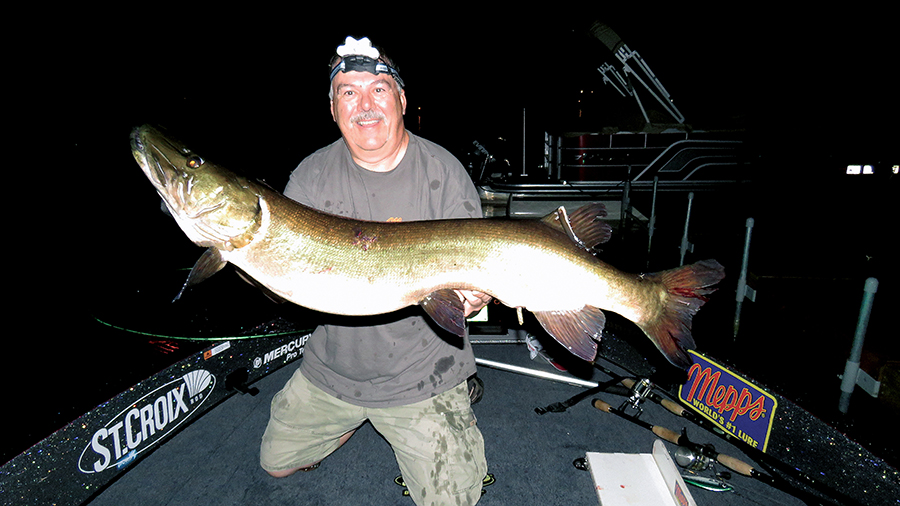
Three cranks later my shoulders were jolted as a big musky struck the soft plastic lure. My hookset was solid, and wild headshakes telegraphed up the braided line, crazily rocking the rod’s tip. Before I could switch on my headlamp, the fish jumped in the darkness to gain slack, and I reeled like a madman to catch up. Feeling the weight of the fish again, I breathed a sigh of relief and resumed the battle.
In the glow of the headlamp the muskie’s size was impressive, but I chuckled at the swimbait sticking from the corner of its mouth like a fat cigar. Having grabbed the lure with a headshot, the fish had obviously been serious about feeding. As soon as the fish was boatside I moved quickly with the net, and another last light musky was mine. After a few quick photos I eased it back into the lake and watched its tail paddle side to side as it waved goodbye, gained depth and was gone.
You’ll hear the term “feeding window” used in musky fishing to describe when they are triggered to bite by moon events, sunrise and set, and weather changes. All matter sometime during the season, but I firmly believe there is no greater feeding window than the last hour or so as day transitions to night. Fish and animals are said to be crepuscular if they are active in twilight, but I’ve caught enough muskies at all hours of the day to know this doesn’t necessarily apply to them. Muskies’ eyesight is notoriously good and they will feed day and night, and possibly this provides the explanation.
Does approaching darkness give them a sudden, visual advantage over baitfish? I think this is likely, just as walleyes have been found to have an advantage over perch as the sun lowers in the sky. But as with so many other aspects of musky fishing, it’s best not to worry about the “why” and to simply take advantage of any edge you may find.
For proof of how good last light musky fishing can be, I checked my personal catch records which I’ve maintained for almost 30 years. I found that I’ve caught muskies during the last light period from almost every lake I have fished, although some waters are better than others. In fact, of all the muskies I’ve caught from my favorite Wisconsin lake, over 56 percent have been hooked in the final hour of daylight.
Considering the way I prefer to fish on the lakes near home, it makes sense that I catch a lot of muskies in low light. So, I took my research a step further and analyzed my musky catches on Lake of the Woods, where I’ve fished for two to three weeks per year for nearly a quarter-century. While there, I fish from morning until dark, with a day’s fishing usually lasting more than 12 hours. Suspended baitfish are inconsequential as most fishing is done around shallow structure and weedbeds. I found that more than 26 percent of the muskies caught from my boat on Lake of the Woods have been taken in the day’s final hour despite my effort extending throughout the day. Therefore, my catch records prove lowering daylight is the most important time to be fishing for muskies.
There is nothing special in the tactics I use for last light muskies, with the exception that I want my lure running shallow regardless if I’m casting to a rock reef or bombing casts over a 50-foot deep basin. Muskies’ eyes look up and they prefer to strike from below, and a bait silhouetted against the surface is a perfect target regardless of the depth of water I’m fishing. Thus, I use topwaters, bucktails, swimbaits and shallow-running crankbaits around weeds and rocks, as well as over deep water. The only time I will change to a deep-diving crankbait is when fishing for suspending muskies and my electronics show the ciscoes are staying in the 10- to 15-foot range. Even then I’ll use twitches and pauses to keep the crankbait in the five- to 10-foot zone.
Because a dark musky back is almost impossible to see in darkening water, a wide figure-eight after every cast is crucial to success. You should be doing this all day every day anyway, but it may be difficult for someone to buy in until they experience a boatside strike from an unseen fish.
Also, last light is the best time to return to a musky that followed earlier. Again, this isn’t a time to worry about the why. Just know that if you want to catch a fish that followed you have to go back and try again, and the best time to do this is just before dark. The next time you’re dog tired and sunburned from a day of musky fishing and the lure of dinner and a cold one is strong, stick it out just a little longer and take advantage of the last light bite. It won’t be long until you’re convinced that just before nighttime is the right time.


