
By Steve Heiting
As I eased my boat over the lip of a deep breakline, the hairs on the back of my neck stood on end. I just knew a big musky was in my future. A dirty denim sky hung to the west, and each breath of the soggy air seemed to flow in and out of my lungs. Loons wailed and an eagle hung low over the lake, hunting the ciscoes that dimpled the surface. Nature was telling me a storm would hit later.
A half-hour later, with my swimbait scooting beneath the surface on its perilous journey to the boat, I questioned why I had actually never seen a musky eat the lure type. I had already caught dozens of muskies on swimbaits and witnessed hundreds of muskies strike other kinds of lures, but I had yet to see one eat a swimbait at my feet. All of the swimbait strikes I had experienced to that point were far from the boat.
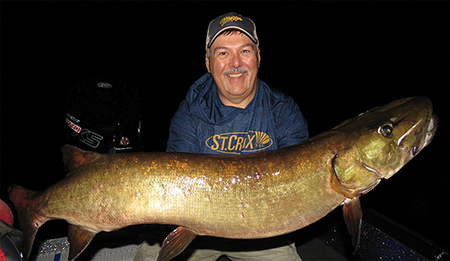
Then it happened. Ten feet away the water parted as a big tail swung side to side and a mouth the size and color of an ice cream bucket opened and then slammed shut on the lure. Instantly I was locked in a toe-to-toe struggle with a hefty northwoods musky, the kind that bears the color of and is built like a National Guard truck. Through the battle, I’m not really sure I breathed until the fish slid into my net. A nearby angler who watched the goings-on from a distance kindly jumped into my boat to take photos, and soon the fish was released back to the depths.
Swimbaits are the newest iteration of soft plastic or “rubber” baits, as some like to call them. Many musky anglers were initially slow to embrace swimbaits, but the lure style that is huge in the bass fishing world is fast becoming an increasingly popular option for long, toothy fish. Perhaps it’s because most musky lures rattle or spin their way through the water, while the soft shimmy of a swimbait seems like just not enough motion to invoke the attention of a big musky.
Have you ever watched a bass in the shallows dart out of your boat’s path? A fish can swim remarkably fast with a simple wiggle of its tail — which the motion of a swimbait’s paddle-shaped tail closely resembles. It’s the imitation of the action and “feel” of real baitfish that makes all soft plastic lures so effective, and swimbaits are the most similar of all.
Two Wisconsin tackle companies produce what are arguably the most popular of swimbaits at this writing. Musky Innovations offers its Swimmin’ Dawg and Chaos Tackle produces the Posseidon. Both the Swimmin’ Dawg and Posseidon are available in a myriad of colors.
At their introduction, many fishermen saw swimbaits as a cast-back style, a subtle offering you would instantly throw back to entice a musky that had just followed but didn’t strike a different lure. For me, I saw swimbaits as an option for casting to open water muskies in northern Wisconsin, but I was initially hesitant because I believed their action may be too indistinct in what some call the “great ether.” However, when I caught three muskies in about an hour one night in a rainstorm, I knew I had underestimated the bait’s appeal as well as the muskies’ predatory abilities.
Like other soft plastic lures, there really is no wrong way to retrieve a swimbait. You can count them down and fish them at any depth, or keep them just under the surface. A pull-pause-pull retrieve works for many anglers. I often fish swimbaits like a bucktail, speeding up and slowing down the speed periodically throughout the retrieve. It was just after such a burst of speed when the musky struck in the opening anecdote of this article.
And, as many expected at the outset, swimbaits have proven to be terrific as a natural-appearing, cast-back option to muskies that followed a more aggressive style of lure but didn’t bite. Because they can be fished at any speed, with any action at any depth, swimbaits are effective throughout the season and can’t be pigeon-holed as a spring, summer or fall lure. For every angler who does well with them in the summer, there is another who loves casting them in late fall.
The action of smaller swimbait models seems to benefit from a lightweight Stealth Tackle Twitchbait steel leader and the use of a medium-heavy action muskie rod. Larger models have enough bulk and action that any style of leader will work well, though their weight demands a heavy-action rod.
As with other soft plastic lures, the strike of a musky isn’t always as dramatic as described earlier. Often, it’s no more than a “tick,” a “thunk” or simply extra weight on the line that indicates a bite, so it’s best to set the hook on anything that feels different. If you still aren’t convinced of the effectiveness of swimbaits, consider this.
Rarely do I miss a hookset when a musky strikes one. Many fish end up with the whole lure in their mouth, or have it T-boned just as they would grab a perch, sucker or cisco.
The muskies are convinced. Why shouldn’t you be?